- Irish Roots Heritage Plus
- Posts
- The Lake Isle of Innisfree: I hear it in the deep heart’s core. Part 3
The Lake Isle of Innisfree: I hear it in the deep heart’s core. Part 3
Memory, Exile, and the Echo of Innisfree

Irish Roots
August 03, 2025

Low waves move through golden mist as morning breaks over Innisfree
I will arise and go now, for always night and day
I hear lake water lapping with low sounds by the shore;
While I stand on the roadway, or on the pavements grey,
I hear it in the deep heart’s core.
Dear Reader,
We’ve walked now through the vow to arise, and the peace that comes dropping slow.
In this final part, Yeats brings us somewhere unexpected: not to Innisfree, but away from it.
And yet the poem doesn’t fade. It deepens.
The sound remains.
Even in the noise.
“I will arise and go now, for always night and day”
The line returns — exactly as it opened the poem. But it’s heavier now. Not a future hope, but a repeated refrain. A rhythm that won't leave him alone.
The vow isn’t gone. It’s ongoing.
Because Yeats is no longer speaking from a place of desire. He’s speaking from its absence.
“I hear lake water lapping with low sounds by the shore”
This isn’t memory in the usual sense. It isn’t visual or distant. It’s sound — internal, alive, repeating.
He doesn’t recall the lake. He hears it. And that hearing isn’t past tense. It’s present. Continuous.
Water laps — slow, low, rhythmic. It becomes a metronome.
Not just of nature, but of inner life.
“While I stand on the roadway, or on the pavements grey”
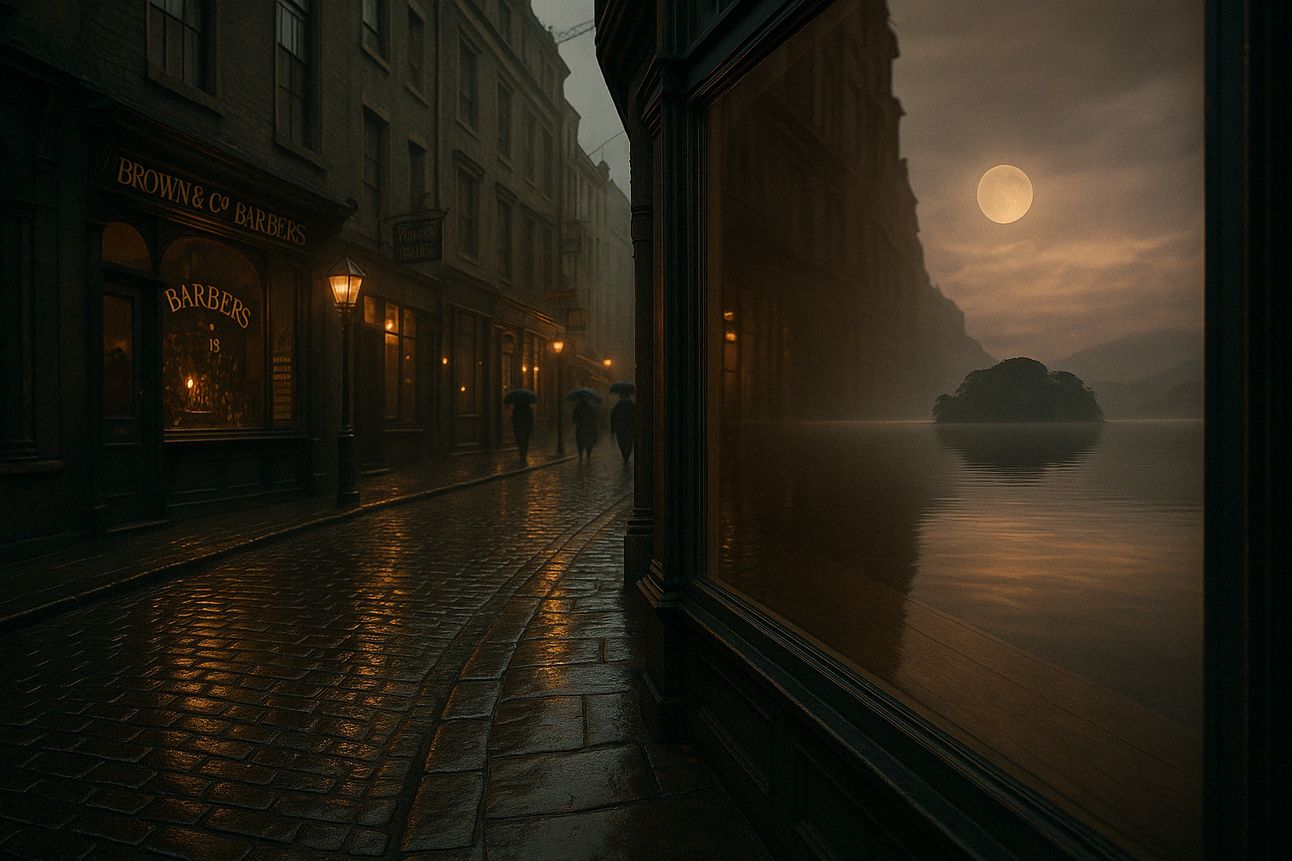
On a rain-slick London street, a shop window holds another world — the moonlit echo of Innisfree, still visible in the heart’s reflection.
Now the setting is exposed: he is not in nature, not even near the lake. He’s in the city — likely London — surrounded by concrete, movement, modernity.
The “pavements grey” are more than backdrop. They’re opposition.
They flatten colour. They mute sound. They symbolise disconnection — from land, from rhythm, from stillness.
And yet...
“I hear it in the deep heart’s core.”
It’s still there.
That low, lapping rhythm hasn’t stopped.
For Yeats, the “deep heart’s core” isn’t sentiment.
It’s spiritual — the deepest register of knowing.
The place where memory becomes identity. Where absence becomes presence.
This is not nostalgia.
It’s continuity.
🌊 Memory as Sound, Sound as Survival
This final stanza holds more than longing. It holds persistence.
The lake isn’t something he once knew. It’s something he continues to carry.
Even in exile. Even amid movement. Even among the “pavements grey.”
And that’s what makes the poem endure.
It doesn’t rely on being there. It’s about remembering how to hear — even when you’re not.
This is the power of cultural memory.
It doesn’t always shout. It hums.
Not above the noise — but through it.
📖 Exile, but Not Absence
This poem was first published in 1890, in the National Observer, and then revised into The Rose (1893). Yeats was still a young man — living between London, Dublin, and Sligo. He didn’t own a cabin or tend bean-rows. But he was already searching for a rhythm he couldn’t find in cities.
Some have called this poem escapist. But Part Three proves otherwise.
Yeats doesn’t escape.
He remembers.
And in remembering, he refuses erasure.
The heart’s core becomes a repository. A tuning fork.
Even when the world forgets, the body remembers.
And that memory isn’t vague or abstract.
It’s specific — water lapping, low sounds, wings, veils, glimmer.
In other words: it’s felt memory.
It’s acoustic inheritance.
🧭 For the Diaspora, For the Disconnected

Do you dream of your own Innisfree?
This final stanza speaks most directly to those who’ve never lived in Innisfree — and maybe never will.
You don’t have to be by the lake to carry it.
You don’t have to speak Irish to feel the rhythm of its syllables.
You don’t need to stand on Irish soil to feel its stories move beneath you.
And for those raised far away — in New York or Sydney, Boston or Birmingham — this poem offers something rare:
Not guilt. Not grief.
But a quiet permission to belong, even from a distance.
🪶 Why This Final Stanza Matters
Some final stanzas close the poem.
This one opens it again — deeper.
The beginning was a vow. The middle, a rhythm.
But this… this is an echo.
The kind that lingers long after the sound has passed.
The kind we mistake for silence — until we learn to hear differently.
Even when there is no lake. No glade. No cabin.
The heart remembers.
And in that remembering — we begin to return.

Irish Roots Heritage Plus isn’t a look back. It’s a rhythm we walk with.
One that moves through archaeology, poetry, landscape, folklore, and lettered memory.
Enjoy a 1-month free trial - explore everything with no commitment, cancel anytime.
Over 75,000 people already follow us for Irish stories on social media —
but this is where the deeper reflections live.
Irish Roots Heritage Plus offers slower stories, richer insight, and a quiet space away from the scroll.
“It feels like a retreat in my inbox — I slow down the moment I start reading.” — J. Donnelly (subscriber)
🔁 Where We End — and Begin Again
This series has walked the arc of Yeats’s poem, line by line:
A vow to arise
A rhythm to dwell within
And a sound that never leaves
If you’ve followed from the beginning — thank you.
Remember, all three pieces are waiting for you, anytime you wish to return.
Which part stayed with you longest?
And what sound — from your own Innisfree — do you still carry?
Until then —
May the lapping rhythm find you again, even here. Even now.
In the deep heart’s core.
Reply